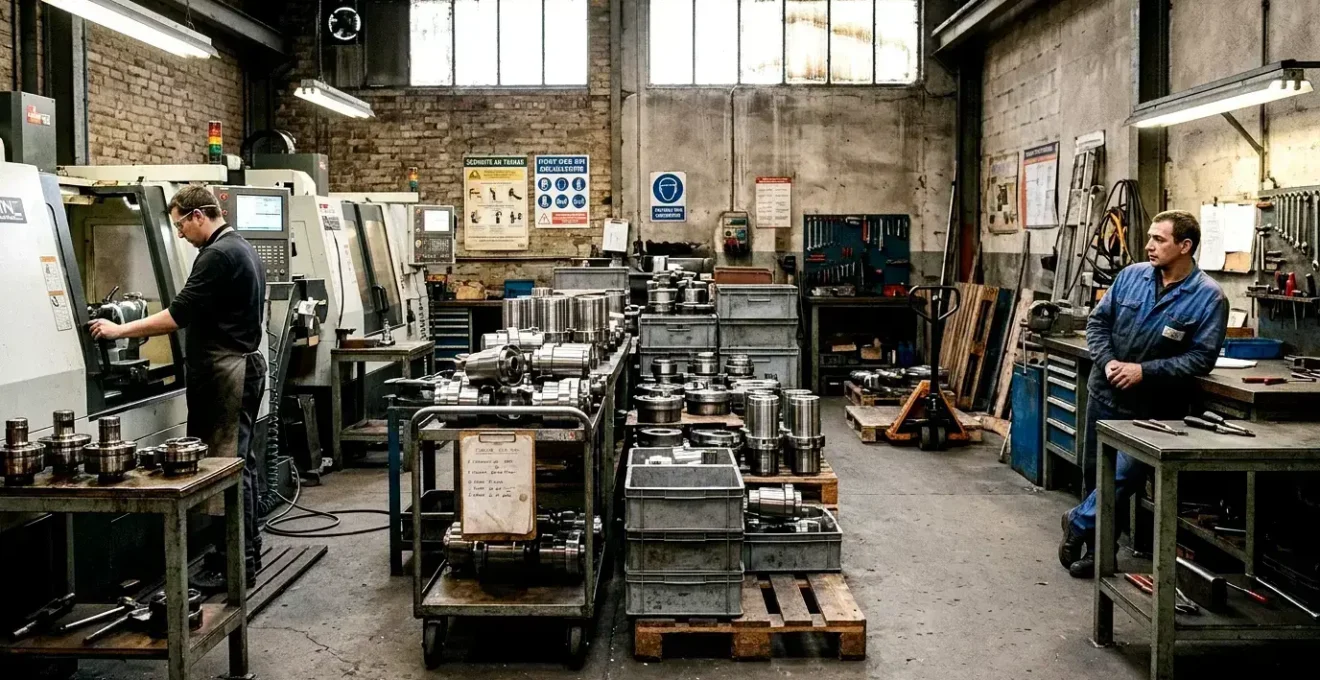
Industrial production chains rarely lose efficiency because every workstation lacks capacity. More often, output is restricted by a particular operation, a poorly synchronized handoff, a missing component or a scheduling decision that prevents available resources from working together.
Adding machines or personnel can appear to be the fastest response. Yet additional capacity does not necessarily increase finished output. If the underlying constraint lies in material availability, changeovers or production sequencing, the investment may simply create more work-in-progress, fixed costs and operational complexity.
Reducing bottlenecks requires managing the production chain as an interconnected system. Production managers must establish where orders wait, determine why flow is interrupted, coordinate resources around the limiting operation and distinguish temporary disruption from structural insufficiency.
For industrial SMEs in France, this also means considering subcontracting, shared machinery, workforce versatility and financing commitments. The objective is not to maximize the productivity of every station independently, but to improve reliable throughput while maintaining enough flexibility to accommodate changes in demand.
Key principles for reducing production bottlenecks
- Measure throughput, queues and actual cycle times across the entire production chain rather than optimizing individual machines in isolation.
- Improve sequencing, changeovers, material availability and coordination before committing to additional equipment.
- Invest in capacity or redesign only when observed constraints remain structural after practical flow improvements have been tested.
- Why Can Improving One Production Stage Slow the Rest of the Chain?
- How Can You Map an Industrial Production Chain to Find Its Main Bottleneck?
- More Capacity or Better Flow: Which Solves a Production Bottleneck First?
- Which Supply and Process Dependencies Can Stop an Industrial Production Chain?
- When Should an Industrial Production Chain Be Redesigned Instead of Fine-Tuned?
- Which Fundraising Methods Can Create Unwanted Long-Term Constraints?
- Why Do Operational Problems Multiply When a Small Business Starts Growing?
- How Can You Build Business Processes Without Turning a Small Company Into a Bureaucracy?
Why Can Improving One Production Stage Slow the Rest of the Chain?
Improving one production stage can slow the overall chain when its additional output exceeds the capacity of the next operation or disrupts established production sequencing. Parts accumulate, handling requirements increase and downstream stations receive work irregularly. The local productivity gain therefore fails to translate into higher finished-product throughput and may create additional coordination problems.
Consider a hypothetical machining workshop with three sequential operations. Cutting can process 80 parts per hour, drilling 50 and finishing 70. Increasing cutting capacity to 100 parts per hour does not allow the chain to deliver more than 50 completed parts per hour under these simplified conditions, assuming drilling remains the sole constraint and no losses or alternative routes intervene.
Instead, the faster cutting station generates additional intermediate inventory before drilling. More parts must be stored, identified, moved and monitored. If managers prioritize orders according to individual machine availability, drilling may also receive batches in a sequence that conflicts with delivery priorities.
This illustrates a central principle of the Theory of Constraints: system throughput is limited by the effective capacity of its governing constraint, not by the average productivity of all workstations. The principle is discussed in ASQ‘s Six Sigma Green Belt handbook on production constraints, whose framework distinguishes improving a local operation from increasing the output of the entire system.
Local performance indicators can therefore be misleading. Machine utilization may rise even while customer lead times deteriorate. A workstation producing more parts may appear successful despite increasing work-in-progress and consuming additional storage space.
Secondary effects become particularly important in environments with multiple product references. Excess production can delay quality detection because defective batches remain in intermediate inventory before reaching inspection. Production planners may also spend more time resequencing orders, organizing transfers and resolving priority conflicts.
Before introducing a workstation improvement, managers should verify four conditions:
- The downstream operation has sufficient effective capacity to absorb the additional output.
- Intermediate buffers can accommodate necessary variation without uncontrolled accumulation.
- The proposed change supports the delivery sequence rather than merely maximizing equipment utilization.
- Quality checks can detect defects without allowing larger batches of nonconforming parts to accumulate.
Where downstream absorption is insufficient, the improvement may still be useful for reducing energy consumption, maintenance exposure or operating hours. It should not, however, be presented as a throughput increase without evidence.
Once managers stop treating every station as an independent productivity target, the next task is to locate the operation or dependency that actually governs delivery performance.
How Can You Map an Industrial Production Chain to Find Its Main Bottleneck?
Map an industrial production chain by following material and information from order release to finished-product dispatch, recording actual cycle times, queues, inventory and process dependencies. The main bottleneck is the resource or condition that persistently restricts system throughput. Inventory accumulation provides an important clue, but its cause must be checked against scheduling, quality and capacity data.
A practical starting point is value-stream mapping. The Lean Enterprise Institute‘s Value Stream Mapping reference describes how current-state mapping makes material movements, information exchanges and disconnected processes visible before managers design improvements.
The map should reflect actual workshop conditions rather than an idealized sequence extracted from routing documents. Nominal cycle times alone can conceal changeover losses, breakdowns, waiting for material and interruptions caused by priority orders.
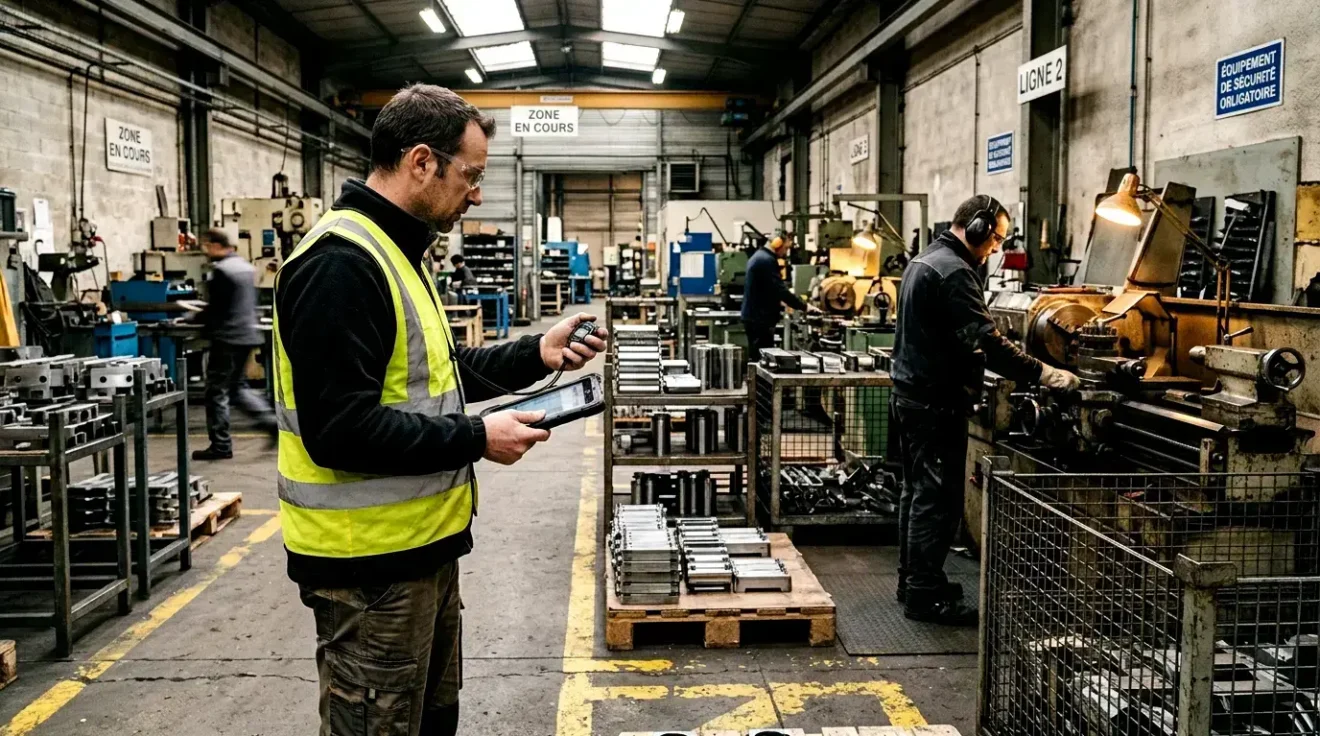
Begin by identifying the product family being studied. A machine may constrain one product route while remaining underused for another. Mapping all references together without distinguishing their routes and changeover requirements can obscure the real constraint.
Then record the operational sequence and the actual condition of each stage. A useful mapping exercise follows five actions:
- List the operations, subcontracted steps, inspection gates and material transfers required to complete the selected product family.
- Record actual processing times, changeover durations, available operating time and interruptions, comparing them with nominal standards.
- Observe queues before and after each operation, including quantities, waiting durations and reasons for holding material.
- Compare effective output with the release rate and customer demand, identifying resources that remain persistently overloaded.
- Review the observations across different shifts, product mixes and production periods before classifying the constraint.
Three different bottleneck types deserve separate diagnoses:
| Type | Typical evidence | Initial response |
|---|---|---|
| Capacity bottleneck | Persistent queue before a saturated machine or labour resource | Recover available capacity and assess structural demand |
| Flow bottleneck | Waiting caused by large batches, changeovers, transfers or handoffs | Change sequencing, batch sizes or transfer rules |
| Information bottleneck | Late work orders, incorrect priorities or missing production instructions | Improve planning data and release coordination |
These categories are practical diagnostic tools rather than mutually exclusive physical properties. A machine with a long queue may be constrained by inadequate material availability during part of the week and excessive changeovers during another.
French industrial SMEs often require additional attention to shared resources. A multi-skilled operator may serve several stations, while one machine supports multiple product lines. The effective bottleneck may therefore be the availability of a common resource rather than an individual workstation.
Five actions to verify the bottleneck before investing
- Draw the actual production route and deliver a current-state flow map showing every processing stage and handoff.
- Time representative production cycles and deliver a comparison sheet of nominal times, observed times and major interruptions.
- Count waiting inventory at the same observation points and deliver a dated queue register identifying where work accumulates.
- Classify the likely constraint and deliver a brief diagnosis supported by capacity, flow or information evidence.
- Test a limited improvement, then deliver a before-and-after record of throughput, waiting inventory and delivery reliability.
A short weekly review can help detect bottleneck migration after changes, particularly where demand or product mix varies. Weekly frequency is a practical management choice, not a universal industrial requirement; unstable operations may need more frequent checks.
With the constraint located and classified, managers can determine whether the next improvement should change the way available resources are used or increase their capacity.
More Capacity or Better Flow: Which Solves a Production Bottleneck First?
Improving flow should generally precede adding capacity when a production bottleneck results from avoidable waiting, poor scheduling, unnecessary changeovers or excessive batching. Capacity investment becomes appropriate when the governing resource remains structurally saturated after recoverable losses have been addressed. The correct decision depends on constraint type, sustained demand, implementation time and financial exposure.
Buying additional equipment appears attractive because it offers a visible increase in theoretical output. However, theoretical capacity becomes valuable only when materials, operators, quality controls and downstream operations can use it.
Flow improvements often recover productivity through better coordination rather than additional fixed assets. Smaller production batches can shorten waiting time. Improved changeover preparation can increase effective machine availability. Resequencing orders around the governing constraint can reduce interruptions and urgent scheduling changes.
The two approaches involve different costs and execution risks.
| Decision criterion | Improve existing flow | Add production capacity |
|---|---|---|
| Primary intervention | Sequencing, setup, buffers, handoffs and scheduling | Equipment, staffing, shifts or external processing |
| Financial commitment | Often lower capital expenditure, with ongoing management effort | Potentially significant investment and recurring operating costs |
| Implementation | Can often be tested incrementally | May require procurement, installation and qualification |
| Main risk | Improvements erode without consistent execution | Unused capacity if demand or constraints change |
| Best fit | Recoverable flow losses and coordination constraints | Verified, sustained capacity shortage |
A useful decision sequence starts by examining available operating time at the constraint. Are avoidable breakdowns consuming production hours? Are changeovers longer than necessary? Is the machine regularly waiting for instructions, tools, operators or approved material?
If these interruptions can be reduced, additional equipment may be unnecessary. A shift in scheduling rules or smaller transfer batches can sometimes improve finished output without changing nominal capacity.
Nevertheless, flow improvement is not an unlimited substitute for capacity. Investment deserves priority when the constrained resource remains saturated under a realistic production plan, avoidable losses have already been reduced or essential contractual delivery requirements cannot be satisfied within the improvement window.
Additional capacity should also be evaluated against changing demand. A machine purchased for a temporary peak can remain underutilized when orders return to normal. Conversely, refusing investment despite a demonstrated long-term deficit can create persistent late deliveries and excessive overtime.
The financial consequences extend beyond the acquisition price. Equipment may require maintenance, energy, floor space, tooling and specialized labour. Such commitments reduce flexibility if the manufacturing layout must later change.
Before approving expenditure, managers should compare credible low-demand and expected-demand scenarios. They should also confirm that the proposed investment increases the output of the complete production system rather than shifting waiting inventory to another stage.
Even a correctly sized production line can stop when a critical input or shared resource becomes unavailable, making dependency management the next priority.
Which Supply and Process Dependencies Can Stop an Industrial Production Chain?
An industrial production chain can stop when a critical supplier, component, shared tool, utility, quality approval or specialized employee becomes unavailable. The most disruptive dependencies combine high operational criticality with long recovery times and limited alternatives. Effective resilience therefore requires identifying where interruptions propagate, rather than duplicating every resource or holding excess inventory throughout the factory.
Dependencies extend beyond the visible sequence of machining and assembly operations. A production order may require specific material certification, a subcontracted treatment, calibrated tooling and final quality release before the next stage can proceed.
When these conditions must occur in sequence, one missing input can delay several downstream activities. Recovery may become especially difficult when the missing component has a long procurement lead time or the process cannot accept an alternative.
The main dependency categories include:
- Single-source suppliers: a critical component cannot be obtained quickly from another qualified provider.
- Long-lead-time materials: replenishment requires more time than the production schedule can absorb.
- Shared equipment and tooling: multiple product routes compete for the same limited resource.
- Energy and utilities: electricity, compressed air or another essential service becomes unavailable.
- Quality-release dependencies: required inspection results or a failed batch prevent downstream processing.
- Concentrated operational knowledge: only one employee can perform a critical setup or maintain a specialized program.
External subcontracting is particularly relevant in French industrial value chains. According to Insee‘s statistical study of the French automotive industry, subcontracting enabled ordering companies to access expertise and production resources in 2023. The findings concern the automotive sector and should not be generalized statistically to all French manufacturing businesses.
72%
Of surveyed ordering companies in the French automotive value chain reported subcontracting to benefit from suppliers’ know-how in 2023. Separately, 60% reported seeking subcontractors’ production resources. These are reported motivations, not measured evidence of risk reduction or supplier performance.
Insee Première, no. 2083, published December 2025; reference year 2023.
These relationships can improve flexibility, but an external process may also become a critical dependency if no qualified alternative exists.
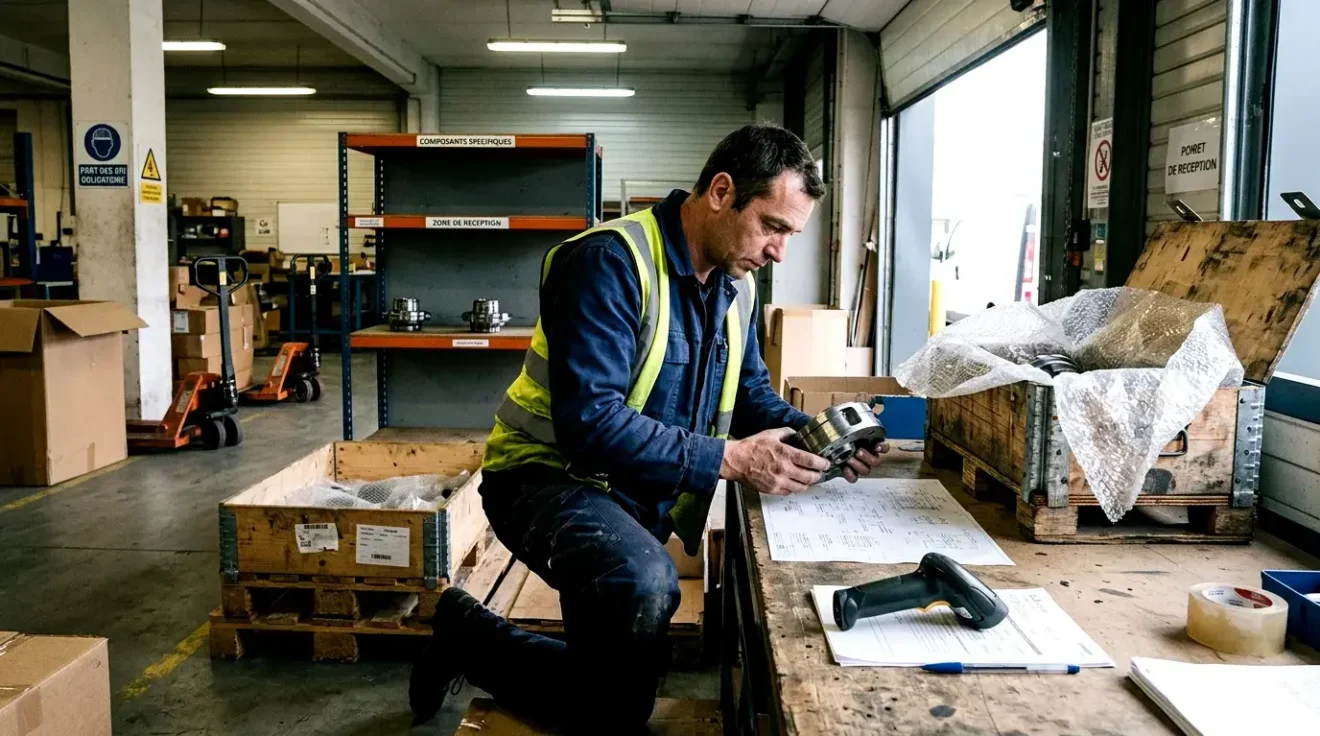
To prioritize risks, assess each dependency using two operational dimensions: the consequences of losing it and the time required to restore an acceptable production rate.
A part that is inexpensive and easy to replace may be low risk despite frequent use. By contrast, a low-cost component that takes weeks to qualify or procure can threaten the entire delivery schedule.
High-criticality, long-recovery dependencies justify targeted mitigation. Depending on feasibility, this may involve a qualified second supplier, a carefully sized safety stock, preventive maintenance, alternative tooling or product redesign.
Safety stock should reflect realistic consumption, replenishment variability and recovery requirements. It should not be determined solely by an arbitrary inventory target, and it should not conceal a recurring process failure.
Personnel dependencies require equal attention. If only one operator knows the setup sequence for a critical machine, absence can create the same disruption as a supplier outage. Cross-training, validated operating instructions and supervised competency checks help reduce this exposure.
Risk registers become most useful when they identify the responsible person, the affected product routes, the available alternatives and the expected recovery method. A dependency without a documented recovery action remains an unresolved operating risk.
If repeated disruptions persist despite effective dependency management, the production architecture itself may no longer fit operational requirements.
When Should an Industrial Production Chain Be Redesigned Instead of Fine-Tuned?
An industrial production chain should be redesigned when recurring bottlenecks arise from its underlying layout, routing or resource architecture rather than isolated operating losses. Redesign becomes more defensible when incremental improvements deliver diminishing returns, product requirements have changed permanently or coordination complexity grows faster than throughput. The decision must account for disruption, investment and demonstrated demand.
Fine-tuning adjusts an existing system. Managers might reduce changeover time, modify buffer limits, improve work instructions or rebalance schedules without changing the essential production route.
Redesign changes the structure within which operations occur. It may involve reorganizing work cells, separating product families, changing production routes, reallocating shared resources or fundamentally revising the relationship between internal manufacturing and subcontracting.
The distinction matters because an inefficient operation can usually be improved within the current system, while an unsuitable architecture repeatedly recreates the same constraints.
Several signals indicate that fine-tuning may be approaching its limits:
- The same bottleneck returns after successive corrective actions.
- Additional buffers and workaround procedures increase complexity without improving delivery performance.
- Product diversity or required routing differs substantially from the assumptions behind the original layout.
- Shared equipment creates unavoidable conflicts between production families.
- Material handling and internal transport consume an increasing proportion of lead time.
These signals are diagnostic prompts, not automatic authorization for capital expenditure. A recurring queue may still be caused by inadequate scheduling discipline or unstable quality rather than the layout itself.
The most useful decision question is whether the constraint can be removed while preserving the essential production architecture. If repeated, well-executed improvements cannot resolve it because the resource configuration is inherently unsuitable, a structural change becomes more credible.
| Consideration | Fine-tuning | Redesign |
|---|---|---|
| Change scope | Local operating methods and coordination | Production structure, routing or layout |
| Reversibility | Generally easier to reverse | Often harder and more costly to reverse |
| Implementation risk | Usually manageable through controlled tests | Potential interruption to multiple operations |
| Long-term suitability | Best when the architecture remains relevant | Best when the architecture no longer matches requirements |
Successful redesign depends on reliable baseline data. If managers use nominal production times without observing changeovers, rework and actual transfer routes, they risk reproducing hidden constraints in the new layout.
Operators should participate before the target structure is finalized. Their knowledge of recurring exceptions, equipment access and informal workarounds often reveals dependencies missing from process documents.
Quality stability is equally important. Transferring an unstable process to a redesigned production system can make defects harder to trace during the transition.
Implementation should therefore be sequenced around production continuity: validate the proposed route, qualify necessary equipment and processes, test a limited scope where feasible and define recovery arrangements before switching critical orders.
Growth projections must also be challenged. Sustained changes in orders or product mix may justify architectural investment. Hypothetical expansion, unsupported by credible demand, creates a risk of installing costly capacity that remains unused.
Because structural changes often require financing, technical justification must be considered alongside the long-term obligations attached to investment funding.
Which Fundraising Methods Can Create Unwanted Long-Term Constraints?
Debt, equity investment, asset-based financing and earmarked public funding can all create long-term constraints when their repayment, ownership or spending conditions conflict with production needs. An investment may improve theoretical capacity while reducing financial flexibility. Manufacturers should therefore evaluate financing against realistic demand, asset adaptability and cash generation rather than projected production volume alone.
Production managers sometimes treat financing as a separate decision from workshop operations. In practice, the funding structure influences how easily a company can change equipment, reorganize production or respond to an unexpected decline in orders.
A bank loan creates repayment obligations that generally continue even when production slows. Depending on the agreement, collateral requirements or financial covenants may restrict the firm’s ability to obtain additional funding or dispose of assets.
Equity financing avoids scheduled debt repayments but may involve ownership dilution and investor expectations concerning growth, profitability or exit timing. Those expectations depend on the negotiated investment terms; they are not automatic consequences of every equity transaction.
Revenue-based financing can link repayment to business activity, while asset-based arrangements depend on the value or availability of eligible assets or receivables. Their actual costs, risk allocation and flexibility vary considerably by contract.
Grants, regional assistance and other public funding arrangements may reduce the cost of eligible investments. However, depending on the scheme, conditions can concern expenditure categories, application deadlines, project duration and reporting obligations.
For companies operating in France, Bpifrance Création‘s initial business financing plan provides a framework for comparing investment needs with available financing resources, including working capital and liquidity requirements.
Its approach to financial planning is relevant to manufacturing investment even though the publication addresses business creation rather than industrial capacity optimization specifically.
Consider a hypothetical manufacturer obtaining financing for a second machine based on expected order growth. If the additional orders fail to materialize, the machine’s capital and operating costs remain while the underlying production constraint may still be elsewhere.
Financing has then increased the business’s fixed-cost exposure without delivering a corresponding throughput benefit.
Before committing to funding, managers should verify the following:
- Whether repayments or investor expectations remain manageable under a lower-demand scenario.
- Whether the financed asset directly addresses a validated production constraint.
- Whether the equipment could be reassigned or remain useful after a future layout redesign.
- Whether installation, commissioning and qualification timelines match the financing schedule.
- Whether working capital remains sufficient for inventory, payroll and operational interruptions.
Financing should preserve the ability to adapt the production system, not lock the company into maintaining capacity that changing demand no longer justifies.
The best funding method cannot be determined independently of contractual terms, cash-flow projections and operating requirements. A lower nominal financing cost does not always translate into greater operational freedom.
These financial pressures often become more visible as businesses grow, because expanding order volumes expose weaknesses that informal production coordination previously concealed.
Why Do Operational Problems Multiply When a Small Business Starts Growing?
Operational problems often multiply during small-business growth because orders, staff and production interactions become harder to coordinate than the original informal organization can manage. Unused capacity and flexible working arrangements that previously absorbed disruptions gradually disappear. As utilization rises, undocumented decisions, shared-resource conflicts and unreliable handoffs become persistent constraints on delivery performance.
In a very small workshop, production coordination can occur through direct conversation. Operators know which orders are urgent, managers can adjust priorities personally and problems are often resolved without formal escalation.
This works while operational complexity remains limited. But growth adds interactions between purchasing, planning, production, quality, warehousing and customers.
The coordination workload may increase faster than finished output because each additional order introduces scheduling and material dependencies. More employees can also create additional handoffs, particularly when responsibilities are unclear.
Growth exposes hidden capacity limitations. Previously, an operator could move between stations to absorb temporary overload, or a machine could accommodate unexpected orders during idle time. As utilization increases, the same adjustments become harder to make without displacing other work.
Managers need to distinguish temporary growth pressures from structural weaknesses.
| Observed problem | Potential temporary cause | Potential structural cause |
|---|---|---|
| Late production orders | New-employee onboarding | Inadequate planning and order-release rules |
| Frequent equipment conflicts | Short-term product-mix peak | Shared-resource scheduling architecture |
| Repeated management intervention | Unusual disruption | Decisions concentrated in one person |
| Quality-related delays | Temporary learning period | Unstable process or undocumented requirements |
Temporary shortages may justify limited overtime, temporary capacity or targeted training. Structural problems require changes in responsibility, information flow or operating methods.
Applying temporary fixes indefinitely can make the system more fragile. Constant expediting, for example, may help individual orders while repeatedly disrupting the agreed schedule and delaying other deliveries.
A practical early-warning method is to monitor a compact set of operational indicators:
- Number and proportion of orders delivered late.
- Frequency of emergency schedule changes and expediting requests.
- Rework or nonconformity rates.
- Work-in-progress waiting time at critical handoffs.
A simultaneous deterioration in several indicators is a reason to investigate whether coordination mechanisms are saturated. It does not prove a particular cause without examining demand, quality, staffing and supply conditions.
Managers should also observe whether improvement actions remain effective after the immediate pressure disappears. If the same exceptions recur, the underlying operating process may need a defined structure rather than another temporary workaround.
The next challenge is introducing just enough process discipline to make production reliable without creating approval chains that slow the people doing the work.
Key takeaways before formalizing production processes
- Document the handoffs that affect throughput first; administrative completeness is not an operational objective.
- Use observed disruptions to determine which rules are necessary, rather than importing an entire management system at once.
- Assign clear responsibilities while preserving operators’ ability to resolve routine problems at the point of work.
How Can You Build Business Processes Without Turning a Small Company Into a Bureaucracy?
Small companies can build effective business processes without bureaucracy by documenting essential workflows, responsibilities and handoffs rather than multiplying approvals. The highest-value processes usually protect the bottleneck and coordinate information between functions. Short instructions, operator participation and periodic revision after significant incidents can improve consistency while preserving the flexibility needed in industrial production.
The purpose of a process is to establish a reliable shared reference for performing work. It should clarify what triggers an activity, who performs it, which information is required, what constitutes completion and how an exception is handled.
An approval system has a different purpose: it authorizes or blocks actions. Some approvals are necessary for safety, quality, regulatory compliance or financial control. Others simply repeat decisions that competent operators could make within clearly defined limits.
For a growing manufacturing SME, the most useful documentation usually concerns interfaces where information or material passes between teams.
Three handoffs deserve particular attention:
- Order intake to planning: confirming product specifications, requested delivery dates, quantities and material requirements before scheduling.
- Planning to production: ensuring released orders have usable instructions, appropriate priority and the resources needed to begin.
- Production to shipping: confirming completion status, required quality release and dispatch readiness.
Processes at the governing bottleneck also deserve priority. A consistent setup sequence, a standard method for reporting material shortages or clear rules for releasing work can reduce variation where it matters most.
Documenting noncritical activities before these interfaces are stable may consume management attention without materially improving throughput.
A practical approach is to have the employees performing the work write the first version of each procedure. A one-page description may be enough for a routine handoff, provided it contains the necessary information and can be used independently.
More complex, hazardous or regulated operations may need detailed instructions, technical records and formal controls. The one-page approach should not override applicable safety or quality requirements.
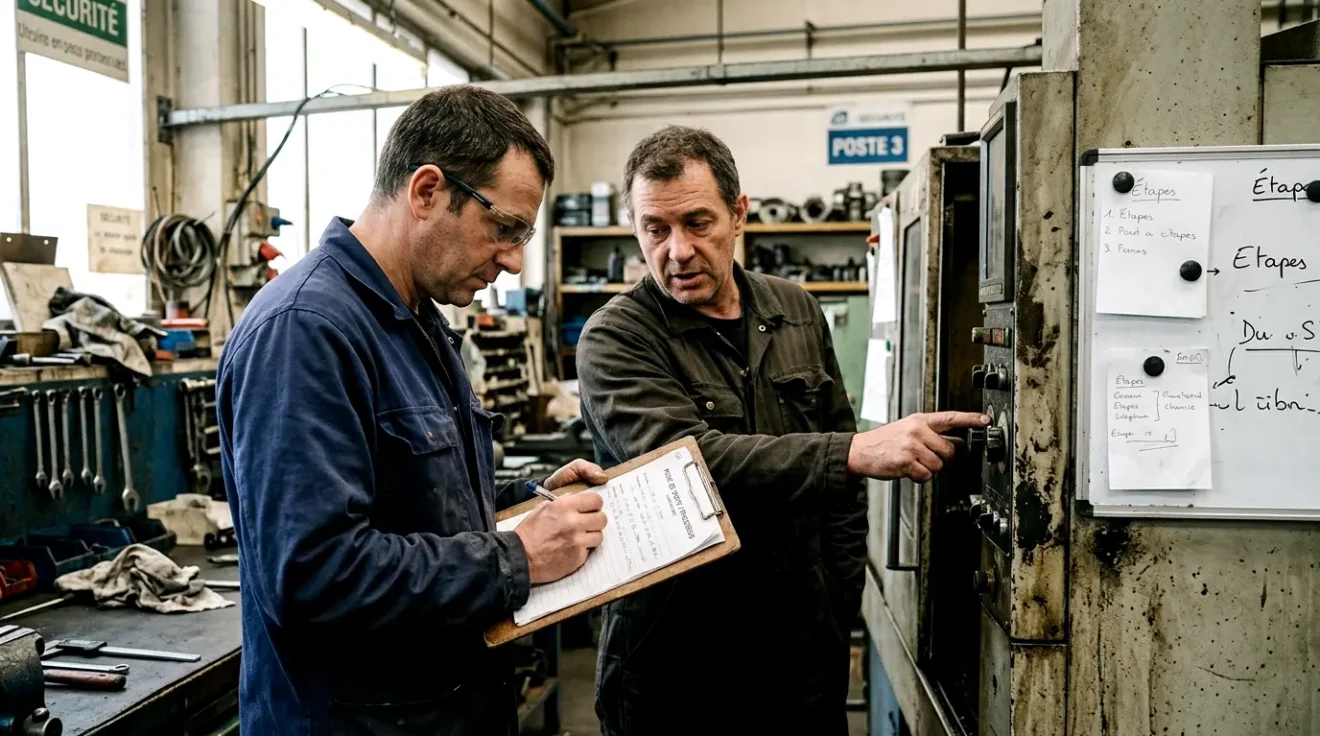
Each new procedure should be tested under real operating conditions. A useful question is whether a trained new employee with the required competence and permissions could complete the routine task using the document without relying on undocumented personal knowledge.
If the answer is no, the missing instructions or decision boundaries should be clarified. If the document merely reproduces information already available and creates another sign-off, its value should be questioned.
Procedures should be reviewed when a significant incident reveals a gap, when equipment or products change, or when operational responsibilities evolve. Required reviews for safety, quality or compliance still need to follow the applicable rules.
An effective anti-bureaucracy test asks what failure each rule is intended to prevent. A rule should have a clear operational, safety, compliance or control purpose. Where its purpose cannot be established and no requirement makes it necessary, removal or simplification should be considered.
Process quality can be judged through outcomes: fewer missing instructions, fewer handoff disputes, reduced rework, more consistent scheduling and less dependence on individual employees.
Start with one frequently disrupted handoff or bottleneck operation. Observe the current work, write a short procedure with its operators, test it on actual orders and compare waiting time, errors and interventions before and after adoption. Keep the process only if it demonstrably improves reliability or fulfils a necessary control requirement.
Can a production line have more than one bottleneck?
Yes. Different product families can depend on different constrained resources, and bottlenecks may shift with demand, scheduling, breakdowns or product mix. Managers should identify the constraint governing the specific flow being studied and monitor whether it changes after improvements. A single snapshot may not reveal the constraint that most consistently affects delivery performance.
Does high machine utilization prove that a workstation is the bottleneck?
No. High utilization indicates that a resource is busy, not necessarily that it restricts overall output. A station can run continuously while producing unnecessary inventory. Bottleneck identification requires examining demand, effective capacity, queues, material availability and the effect of the resource on completed orders.
How often should production bottlenecks be reassessed?
Review frequency should match operational variability. A weekly review can be practical for a relatively stable workshop, while environments with frequent product changes, urgent orders or recurring disruptions may require daily checks. Major changes to equipment, staffing, suppliers or scheduling should also trigger reassessment.
Can outsourcing remove a bottleneck without buying equipment?
Outsourcing can relieve an internal capacity constraint when a qualified subcontractor has appropriate availability, quality capability and delivery reliability. However, transport, inspection, supplier lead times and external dependencies must be considered. The relevant comparison is total system performance and cost, not the apparent capacity transferred outside the factory.
Which metrics show whether bottleneck improvements are working?
Useful indicators include completed throughput, work-in-progress, order lead time, on-time delivery, queue waiting time and effective availability at the constrained resource. Evaluate them together: higher machine output with larger inventories and unchanged customer deliveries does not establish a successful system-level improvement.