
A small business can improve productivity without extending working hours by reducing the time employees spend waiting, correcting mistakes, searching for information and completing unnecessary tasks. The objective is not to make everyone work faster. It is to increase the amount of valuable work completed within existing working hours.
Consider a small French services company where employees regularly finish assignments late. The apparent problem may be insufficient staffing, but the underlying cause could be repeated approval delays, unclear priorities or information scattered across several applications. Adding overtime does little to remove these obstacles.
For managers, sustainable productivity improvements begin with understanding how work moves through the business. Once the main constraints are visible, relatively modest changes to responsibilities, procedures, equipment and communication can improve delivery without intensifying employee pressure.
The following approach combines practical workflow analysis, careful performance measurement and workplace improvements, while accounting for the employment obligations that apply to businesses operating in France.
How to increase output without increasing working hours
- Remove constraints first: identify where tasks wait, approvals accumulate and employees repeatedly correct avoidable errors.
- Simplify before investing: eliminate unnecessary steps, clarify responsibilities and automate only stable, repetitive activities.
- Measure sustainable results: monitor completed work, quality and employee workload rather than hours online or individual activity counts.
- Why Can Longer Working Hours Reduce Productivity Instead of Improving It?
- How Can You Find the 3 Biggest Productivity Bottlenecks in a Small Team?
- Automate, Delegate or Simplify: Which Productivity Lever Should You Use First?
- Which Productivity Tools Can Actually Make a Small Team Less Efficient?
- When Should a Growing Team Introduce Formal Productivity Routines?
- Which Productivity Measures Can Push Employees Toward the Wrong Priorities?
- How Can You Improve a Working Environment With 5 Low-Cost Changes?
- How Can Workplace Productivity Improve Without Increasing Pressure on Employees?
Why Can Longer Working Hours Reduce Productivity Instead of Improving It?
Longer working hours can reduce productivity when fatigue causes employees to complete tasks more slowly, make more mistakes or require additional recovery time. Although total output may initially rise, each additional hour can produce less useful work. The effect depends on the task, working conditions and individual circumstances rather than a universal fatigue threshold.
Managers often confuse total hours worked with productive capacity. An employee who spends ten hours at work has not necessarily delivered more valuable output than someone who works eight hours with fewer interruptions and less rework.
Research reviewed in the OECD Employment Outlook 2022 chapter on working time and productivity indicates that productivity generally declines when working hours become excessively long. However, the OECD also notes limitations in the available evidence and differences between occupations and working arrangements.
The mechanism is especially relevant to work requiring sustained attention. Employees who make complex decisions, write technical documents or solve unfamiliar problems may experience fatigue differently from employees performing standardised tasks. Neither category has one universally applicable point at which extra hours become counterproductive.
The hidden costs are another concern. Overtime may temporarily clear a backlog while increasing the risk of corrections, customer complaints or employee exhaustion. Absenteeism and staff turnover may also become relevant business costs, although their relationship with overtime must be assessed rather than assumed.
Research evidence: working hours and call-handling efficiency
Researchers Marion Collewet and Jan Sauermann examined daily working hours and employee performance among call-centre agents in the Netherlands.
Their research found that average call-handling time increased as working hours increased. This supports the possibility of declining hourly productivity in the activity studied, but it does not establish a universal threshold for French small businesses.
In France, overtime also has direct employment-law implications. Under the French Labour Code provisions on statutory working hours and overtime, the statutory reference for full-time employees is 35 hours per week. Hours beyond the applicable threshold generally attract enhanced remuneration or equivalent compensatory rest. Collective agreements may establish overtime premiums of at least 10%; in the absence of applicable agreed rates, the statutory default is 25% for the first eight overtime hours and 50% thereafter. Specific working-time arrangements can change how these rules operate.
A useful management test is to compare the quality-adjusted output of the first two and last two hours of several comparable working days. Record completed work, errors and task complexity, while accounting for interruptions and differences in assignments. This is an internal diagnostic, not a scientifically established productivity threshold.
If late-day performance is consistently weaker, the next step is to identify which operational constraints are consuming the team’s effective working capacity.
How Can You Find the 3 Biggest Productivity Bottlenecks in a Small Team?
To find the three biggest productivity bottlenecks, observe actual work for one week, measure the elapsed time between receiving and delivering tasks, and identify where assignments repeatedly accumulate. Rank the constraints according to their impact on overall delivery, then classify them as capacity, process or technology problems before choosing a solution.
Start by mapping the work employees actually perform, including informal requests, internal checks and corrections that may not appear in job descriptions. Ask team members to note where tasks arrive, who handles them and what must happen before they can move forward.
Next, distinguish active working time from waiting time. A customer order might take relatively little hands-on work but remain unfinished while an employee waits for management approval. Reducing the time spent performing an isolated task would have limited impact if most of the overall delay occurs elsewhere.
A genuine bottleneck is a point where incoming demand repeatedly exceeds available processing capacity, constraining the flow of work. A task that employees dislike is not necessarily a bottleneck if it does not delay delivery.
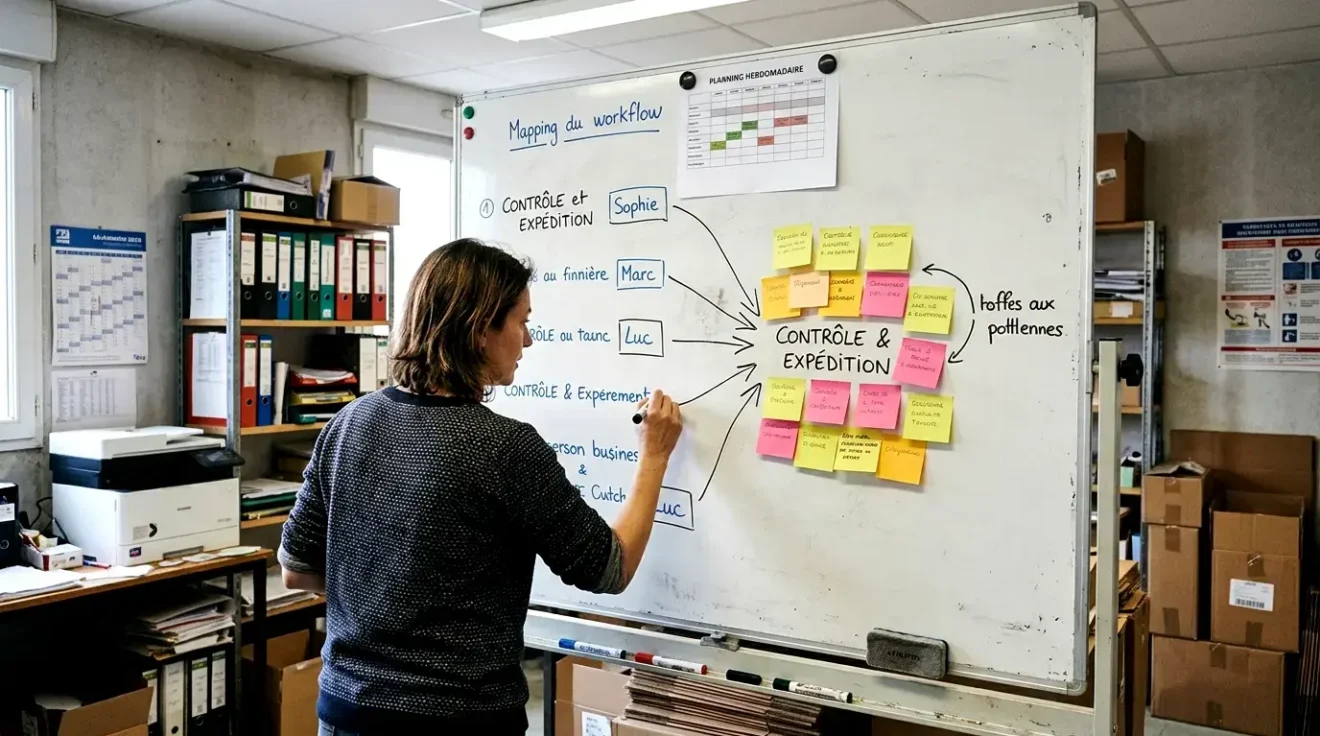
Once the delays are visible, classify each suspected bottleneck. This prevents managers from buying software to solve a staffing problem or assigning additional employees to compensate for an unnecessarily complicated process.
| Bottleneck category | Typical evidence | First intervention to consider |
|---|---|---|
| Insufficient human capacity | Work consistently queues behind a specialist with limited availability. | Redistribute suitable tasks or transfer skills. |
| Poorly sequenced process | Repeated handovers, unnecessary approvals or avoidable waiting periods. | Remove or reorganise process steps. |
| Unsuitable technology | Duplicate data entry, recurring manual transfers or incompatible systems. | Simplify the workflow, then assess tool changes. |
One easily overlooked constraint is the business owner. In a small company, purchasing, customer decisions and routine exceptions may all require the same person’s approval. Track how many tasks are waiting for that person’s response and how long they remain blocked.
A five-action bottleneck diagnosis for your next working week
- Map the workflow: draw the steps for one recurring customer request, producing a simple process diagram.
- Record actual work: collect a one-week task log showing the activity, owner and handovers.
- Measure delays: create a delivery timeline separating active processing time from waiting time.
- Rank constraints: prepare a shortlist of three recurring bottlenecks, each supported by an observable delay.
- Choose one experiment: write a short action plan naming the change, responsible person, measurement and review date.
Once the main constraint has been identified, the challenge shifts from finding the problem to choosing the least disruptive way to remove it.
Automate, Delegate or Simplify: Which Productivity Lever Should You Use First?
Small businesses should generally simplify a task before delegating or automating it. Removing unnecessary steps reduces work immediately; delegation then places remaining responsibilities with appropriately skilled employees. Automation is most useful when a repetitive process is stable, clearly defined and worth the cost of implementation and maintenance.
The order matters because automating a flawed process preserves its weaknesses. A complicated approval workflow does not become efficient simply because software sends notifications more quickly. It may instead generate more alerts and make exceptions harder to resolve.
Begin by asking whether the activity is necessary. Does it satisfy a customer requirement, a legal obligation or a genuine operational need? If not, consider removing it. If it remains necessary, ask whether its steps, frequency or level of detail can be reduced.
Delegation becomes the next option when the task requires judgement, flexibility or coordination but does not necessarily need the manager’s involvement.
Two characteristics help determine which duties to delegate first: task frequency and the consequences of an error.
| Work characteristics | Preferred first approach | Important safeguard |
|---|---|---|
| Unnecessary or redundant activity | Simplify or eliminate | Confirm that no essential requirement is lost. |
| Frequent, low-risk task requiring some judgement | Delegate | Define decision authority and escalation rules. |
| Critical task requiring specialist knowledge | Gradual delegation | Transfer skills and introduce appropriate checks. |
| Stable, repetitive, rules-based activity | Consider automation | Test exceptions, maintenance needs and data protection. |
For a French TPE or PME with a versatile team and limited investment capacity, delegation can sometimes be implemented faster than a new software system. An employee who already understands customer requests may be able to take responsibility for routine approvals once clear authority limits are established.
Automation involves more than an initial subscription. Configuration, integration, training, security, exception handling and maintenance all consume resources. Estimate those costs against the time and error reduction expected from the process.
As a hypothetical example, imagine that every customer quotation requires the manager to manually confirm information that has already been checked. Simplifying the approval criteria and delegating standard quotations may remove the delay without introducing another application.
Automation would become more attractive if a stable, repetitive step remained after these changes and its benefits justified ongoing maintenance.
Even a well-chosen application can become counterproductive if it adds complexity to the systems employees already use.
Which Productivity Tools Can Actually Make a Small Team Less Efficient?
Productivity tools make small teams less efficient when the coordination they require exceeds the time they save. Duplicate data entry, constant notifications, overlapping applications and unnecessary reporting can create additional work. A tool should improve a clearly identified process, replace existing effort and remain manageable for the employees expected to use it.
Small businesses are particularly exposed to tool overload because employees often perform several roles. A team member might update a customer relationship management system, check a project board, respond to messaging alerts and maintain a separate spreadsheet for the same assignment.
Each system may appear useful independently, yet the combined workflow can become slower. Employees spend time moving information between applications and repeatedly switching attention instead of completing customer-facing work.
Before introducing software, examine three questions:
- Frequency: how many relevant tasks will the application improve during a normal working day?
- Replacement: can the application remove an existing tool, manual step or duplicated record?
- Adoption: can employees learn and maintain the new process without creating substantial additional work?
Watch for four practical warning signs: employees enter the same information twice, dashboards are maintained but rarely consulted, notifications interrupt concentration without changing decisions, or staff complete administrative steps solely because the application requires them.
These symptoms suggest that the software is shaping the workflow rather than supporting it. The solution may be to consolidate information, change notification settings, reduce reporting fields or retire an underused application.
A useful review interval is every six months, although rapidly changing businesses may need more frequent checks. Ask what would happen if each application disappeared tomorrow. Which customer deliveries would actually stop? Which tasks would become harder? Which activities would no longer be necessary?
Compare the practical value of each tool with subscription costs, maintenance obligations and employee time. An inexpensive application is not necessarily low-cost if it creates recurring administrative work.
After reducing unnecessary tools, managers should examine whether the team’s coordination practices remain appropriate as the business grows.
When Should a Growing Team Introduce Formal Productivity Routines?
A growing team should introduce formal productivity routines when informal coordination starts causing repeated information loss, unclear responsibilities or avoidable delays. There is no universal employee-count threshold. The right moment depends on the complexity of work, the number of handovers and whether employees can reliably coordinate without constant managerial intervention.
Informal communication often works well in a business with three or four people. Employees share information verbally, the manager remembers commitments, and unexpected problems can be resolved through short conversations.
As the organisation expands, however, the number of potential working relationships grows faster than headcount. More people can create more dependencies, particularly when several roles contribute to a single customer delivery.
Rather than introducing procedures at an arbitrary team size, watch for concrete signals:
- Important information repeatedly fails to reach the next person responsible.
- Decisions are reopened because no one knows what was previously agreed.
- New employees depend excessively on the manager to perform routine work.
- Two employees unknowingly complete overlapping tasks.
- Work is delayed because responsibilities or priorities are unclear.
Start with the lightest routine that directly addresses a recurring problem. A short coordination meeting can clarify urgent dependencies. A weekly priority review can resolve conflicting deadlines. Written communication rules can identify where decisions are recorded and when messages require attention.
The purpose is to make coordination predictable, not to fill calendars. Meetings should have a specific decision or coordination outcome, and participants should be limited to those whose involvement is useful.
A brief decision log can be particularly valuable in a small company. Recording what was agreed, who owns the next action and when it is due reduces dependence on the manager’s memory.
Avoid importing elaborate reporting structures from large organisations without evidence that the business needs them. Multi-level approvals, extensive status presentations and numerous recurring meetings may create more administrative work than they remove.
Review each routine after a short trial. If employees cannot identify an information gap, delayed decision or repeated error that it helps prevent, simplify or discontinue it.
Effective routines make work easier to coordinate, but their success also depends on choosing performance indicators that reward the right outcomes.
Which Productivity Measures Can Push Employees Toward the Wrong Priorities?
Productivity measures become counterproductive when they reward visible activity instead of useful business results. Counting completed tasks, monitoring hours online or demanding rapid email responses can encourage employees to prioritise easy work and constant availability. Small businesses should instead use a limited set of measures reflecting delivery, quality and customer outcomes.
This problem is closely related to Goodhart’s law: when an indicator becomes a target, people may adjust their behaviour to improve the measured number rather than the underlying result.
Imagine a hypothetical customer support team assessed primarily on tickets closed. Employees could improve their scores by selecting simple requests while leaving difficult, high-impact problems unresolved. The dashboard would show activity increasing even as customer experience deteriorated.
Similar distortions can arise from tracking email response time. Employees may interrupt important assignments whenever a notification arrives, although responding immediately adds little value to the business.
The problem is not measurement itself. It is the mismatch between what the organisation wants and what its indicators reward.
| Potentially misleading metric | Better outcome measure | What to check |
|---|---|---|
| Hours connected | Quality-adjusted work delivered | Whether the workload remains sustainable. |
| Number of tasks closed | End-to-end completion time | Whether complex or important tasks are being neglected. |
| Email response speed | Customer issue resolution | Whether fast replies actually solve the problem. |
| Number of items processed | Rework or error rate | Whether increased volume is reducing quality. |
For most small teams, a small set of complementary indicators is easier to interpret than a complex dashboard. Delivery time, rework and customer satisfaction can provide different views of performance, provided the business defines them consistently and considers changes in task complexity.
Measurement should also be transparent. When employees believe every interaction is being monitored to judge their individual effort, they may focus on appearing busy rather than improving processes.
Discuss the purpose of each indicator with the team. Explain how it will support operational decisions, who can access the data and what conclusions it cannot justify.
Reliable measurement becomes more useful when combined with a working environment that supports concentration, comfort and safe working conditions.
How Can You Improve a Working Environment With 5 Low-Cost Changes?
A small business can improve its working environment through five relatively low-cost changes: better ventilation, reduced distracting noise, improved workstation ergonomics, separate spaces or time slots for focused work, and practical break routines. These adjustments can address conditions that contribute to fatigue and disruption without requiring a complete office renovation.
The priority should be to remove observable obstacles rather than purchase cosmetic upgrades. Ask employees which conditions repeatedly interrupt work, create discomfort or make concentration difficult.
Workplace improvements must also be considered alongside the employer’s health and safety obligations, particularly in France, where suitable working conditions are a legal responsibility rather than an optional productivity benefit.

- Improve ventilation and air renewal. Check whether ventilation equipment functions correctly, whether air renewal is adequate and whether maintenance requirements are being met. Window opening may complement suitable ventilation where appropriate, but it does not automatically replace a compliant ventilation system.
- Reduce distracting noise. Separate telephone conversations from concentration-intensive tasks where possible. Adjust notification settings, use available acoustic materials and establish reasonable rules for non-urgent interruptions.
- Improve workstation ergonomics. Review screen height, seating, lighting and equipment placement. Prioritise sources of discomfort and adjust workstations to the tasks and employees concerned.
- Create conditions for focused work. Use quiet areas, shared calendars or agreed concentration periods. Even without a separate room, the team can establish times when non-urgent discussions take place elsewhere.
- Make breaks practical and predictable. Enable employees to take appropriate breaks and vary demanding activities where feasible. Respect applicable rest and break requirements rather than treating breaks as lost productivity.
Intermittent conversations, ringing telephones and frequent digital alerts can be particularly disruptive during work requiring sustained attention because they repeatedly demand a shift in focus. Their actual impact depends on the task and environment, so observing employees’ working conditions is preferable to assuming that every workplace needs complete silence.
French employers must also consider ventilation as part of occupational risk prevention. The INRS guidance on employers’ ventilation obligations explains the responsibilities associated with air renewal, system maintenance and the different requirements for workplaces with specific or non-specific pollution.
Prioritise improvements according to the seriousness of the identified health or safety issue, the number of employees affected, the frequency of the problem and the practicality of the proposed change. Regulatory compliance should not be postponed simply because its productivity benefit is difficult to quantify.
A decorative upgrade with no demonstrated connection to working conditions is different from correcting poor lighting, recurring noise or an inadequate workstation. The latter address identifiable operational or prevention needs.
The most effective environment is one in which employees can complete valuable work without constantly compensating for avoidable physical and organisational disruption.
Key takeaways for small business managers
- Prioritise the constraint that delays customer delivery rather than trying to make every employee work faster.
- Choose one manageable operational change, establish a baseline and review its effects before making further adjustments.
- Treat workload, employee autonomy and working conditions as essential checks when evaluating productivity improvements.
How Can Workplace Productivity Improve Without Increasing Pressure on Employees?
Workplace productivity improves without increasing employee pressure when managers remove unnecessary tasks, reduce waiting time and make responsibilities clearer. The goal is to deliver equal or greater value with less avoidable effort. Sustainable improvements should therefore be assessed through completed work, quality, working hours and employee experience rather than output alone.
The central management principle is to improve the system before demanding more from individuals. When a team is already working hard, additional pressure may conceal the underlying problem while making mistakes, interruptions and fatigue more difficult to manage.
Instead of launching a broad productivity programme, select one operational bottleneck. Establish how it currently affects delivery, choose a proportionate intervention and review the results over a short cycle.
A practical sequence is to identify the delay, record the baseline, change one aspect of the process and compare the outcome. Include employee feedback so that a seemingly faster process is not judged successful if it creates hidden work elsewhere.
Consider a hypothetical business in which quotations regularly wait for management approval. The owner might introduce clear limits allowing a trained employee to approve standard quotations while escalating unusual cases.
The business could then compare delivery time, correction rates and employee workload before and after the change. If quotations move faster without an increase in errors or pressure, the intervention may be worth retaining. If quality deteriorates, the delegation rules or training should be reviewed.
In France, efforts to improve productivity also operate within employment-law and social-dialogue frameworks. Working-time obligations must be respected, and the right to disconnect should be considered when defining expectations about messages and availability outside working hours. The precise obligations and procedures depend on the company’s circumstances and applicable legal or collective provisions.
Employee consultation is not merely a way of gaining acceptance. Team members often know where delays originate, which procedures are redundant and which requests create the greatest disruption. Their involvement can help identify changes that managers would otherwise overlook.
The overall test is whether the team can deliver as much or more useful work over several weeks with no increase in hours or strain, while maintaining quality. If performance improves only because employees skip breaks, remain connected after work or absorb additional responsibilities without support, the apparent gain is not sustainable.
Choose one recurring delay this week, document its current effect on delivery and agree on a small change with the employees involved. Review the outcome using delivery, quality and workload evidence before deciding what to improve next.
Can a small business increase productivity without hiring more employees?
Yes, when existing capacity is being lost to avoidable waiting, rework, unnecessary administration or poorly organised processes. Simplification and better task allocation can increase useful output without recruitment. However, if demand consistently exceeds the team’s realistic capacity after operational improvements, additional staffing or adjusted commitments may still be necessary.
How long should a small business test a productivity improvement?
The test should cover enough normal work to compare results meaningfully. A frequently repeated task may allow useful observations within a few weeks, while seasonal or infrequent activities may require longer. Establish the baseline and review criteria before making the change, and avoid conclusions based on unusually easy or difficult assignments.
What should a manager do if employees resist a new productivity process?
Investigate the specific concern before assuming resistance to improvement. Employees may anticipate additional reporting, reduced autonomy or an unrealistic workload. Explain the operational problem, involve the team in testing alternatives and make clear which existing tasks will disappear. Review whether the change genuinely improves working conditions as well as delivery.
Are French small businesses required to limit employees to 35 hours per week?
No. The statutory 35-hour working week is generally the reference threshold for overtime for full-time employees, not an absolute prohibition on longer hours. Overtime remuneration or compensatory rest, maximum working-time limits, rest periods and applicable collective agreements must be considered. Specific employment arrangements may be subject to different rules.
How can managers tell whether productivity gains are sustainable?
Compare useful work delivered, end-to-end completion time, rework and employee workload over an appropriate period. Check that gains are not coming from unpaid extra hours, skipped breaks or declining quality. A sustainable improvement should reduce operational friction while preserving safe working conditions and reasonable expectations.