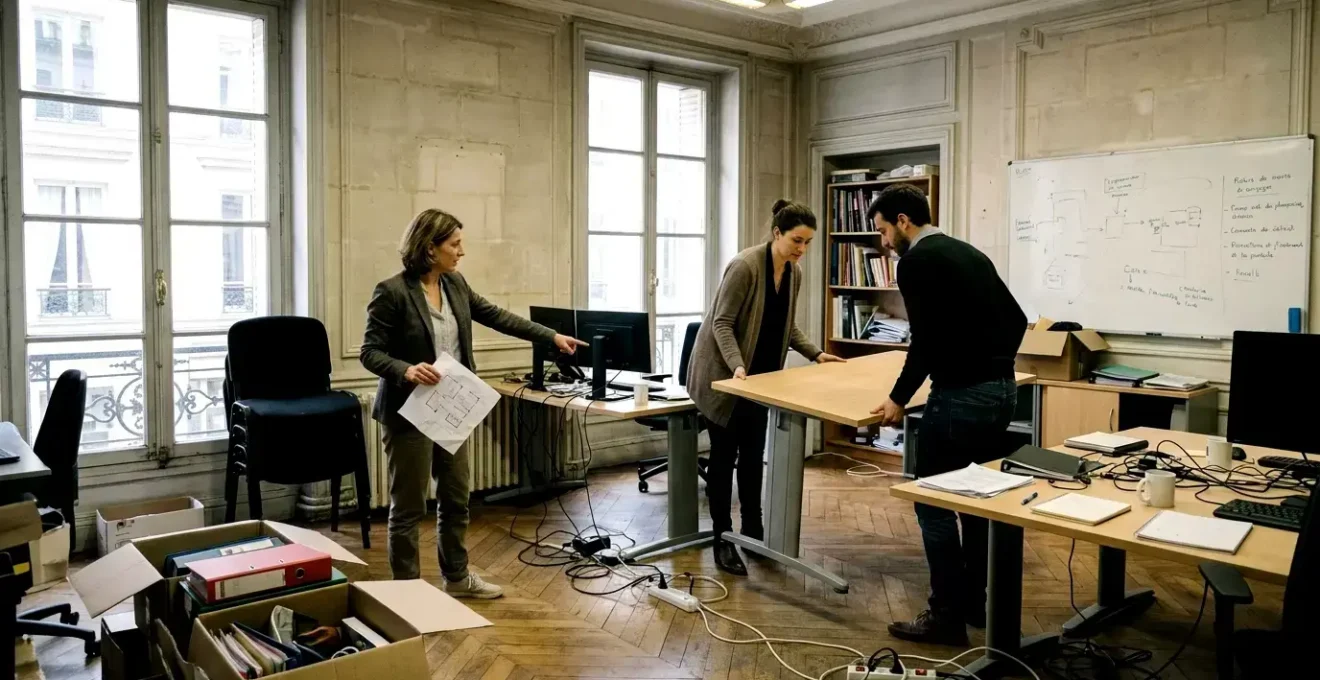
A better working environment does not necessarily require new premises, expensive furniture or a complete office renovation. For many small and medium-sized businesses, meaningful improvements begin by removing everyday obstacles that prevent employees from working comfortably and effectively.
Unpredictable conversations, constant interruptions, poorly positioned desks and unsuitable meeting spaces can consume attention throughout the working day. When these problems accumulate, employees may compensate by working harder, extending tasks or avoiding shared spaces rather than addressing the conditions themselves.
The practical alternative is to identify where effort is being wasted and make targeted changes. Rearranging existing furniture, protecting concentration periods, improving lighting and coordinating office attendance can make work more manageable without substantially increasing overheads.
For managers in France, this also means considering employees’ health, participation and applicable workplace requirements. The objective is not to extract more work from people but to create conditions in which existing responsibilities can be completed with fewer unnecessary obstacles.
What makes a working environment more effective?
- Remove friction first: identify noise, interruptions and layout problems before purchasing equipment.
- Match spaces to activities: provide suitable conditions for concentrated work, collaboration and informal interaction.
- Test and measure changes: involve employees, review results after 30 days and retain improvements that genuinely help.
- Why Can Noise, Interruptions and Poor Layout Reduce Employee Performance?
- How Can You Improve a Working Environment With 5 Low-Cost Changes?
- Open Space, Quiet Zones or Flexible Desks: Which Setup Fits Your Team?
- Which Working Environment Problems Quietly Increase Employee Fatigue?
- When Should You Redesign the Working Environment as the Team Grows?
- Why Do Employees Disengage Even When Working Conditions Seem Reasonable?
- Remote, Hybrid or Office-Based: Which Setup Best Supports Team Productivity?
- How Can Workplace Productivity Improve Without Increasing Pressure on Employees?
Why Can Noise, Interruptions and Poor Layout Reduce Employee Performance?
Noise, interruptions and inefficient office layouts reduce performance by repeatedly breaking concentration and making routine activities harder to complete. Employees must reconstruct their thinking after distractions, move unnecessarily to find equipment or meeting spaces, and work around conversations they cannot control. These losses accumulate even when individual interruptions appear insignificant.
The cognitive cost of an interruption extends beyond the time spent answering a question or checking a notification. Returning to a complex task requires recovering its context, remembering pending decisions and identifying where work stopped.
Experimental research by Altmann and Trafton, described in their research on recovery from task interruptions, examined more than 13,000 interruptions and identified a gradual recovery pattern following task disruption. The experiment demonstrates a recovery process, although it does not establish a universal number of minutes lost per office interruption.
Consider a hypothetical employee preparing a financial report expected to require 30 minutes of uninterrupted attention. If colleagues repeatedly request updates, the task can take longer because the employee must rebuild the calculation context after each exchange. The additional effort is not simply the duration of those conversations.
Managers should distinguish three forms of disturbance:
- Continuous background noise: ventilation, equipment or general office activity may create persistent discomfort, depending on its intensity and characteristics.
- Unpredictable speech: nearby calls and conversations can capture attention, especially during reading, analysis or writing.
- Social and digital interruptions: spontaneous questions, messages and notifications fragment working periods even when the office itself is quiet.
Each problem requires a different response. Moving a printer may reduce equipment noise but will not prevent a colleague from interrupting someone preparing a proposal. Similarly, a communication policy cannot correct poor acoustics.
67%
Share of French working people reported as being disturbed by workplace noise in information published by the INRS. The cited page does not specify the survey date or detailed methodology, so this figure should not be interpreted as a current measurement of office-only exposure.
INRS guidance on workplace noise and open-plan office disturbances
Layout problems create additional friction. Employees may cross the office repeatedly to reach shared supplies, while inadequate meeting space pushes discussions into areas intended for concentration. Desks beside corridors expose employees to movement and spontaneous conversation.
These issues are particularly relevant when a small French business occupies rented premises originally designed for a different activity. Employees cannot individually resolve structural problems involving circulation, acoustic separation or room availability.
A collective diagnosis makes it possible to distinguish environmental obstacles from genuinely task-related difficulties. Once the main sources of disruption are understood, managers can prioritise affordable changes rather than investing indiscriminately.
How Can You Improve a Working Environment With 5 Low-Cost Changes?
You can improve a working environment without major investment by reorganising desks, establishing availability signals, adjusting lighting and ventilation, relocating noisy equipment, and occasionally using shared external spaces. The essential first step is to identify which problems cause the greatest disruption. Targeted changes are more useful than improvements selected mainly for their appearance.
Begin with a one-week diagnostic exercise. Ask employees to record recurring interruptions, uncomfortable locations, unavailable meeting rooms and activities that require repeated movement. The objective is to identify patterns rather than monitor individual productivity.
At the end of the week, discuss which problems are frequent, disruptive and reasonably easy to correct.
Five affordable changes can then be considered according to the findings:
- Reorganise desks by activity and sound intensity. Position conversation-heavy functions away from employees performing demanding individual work. Check circulation and accessibility before changing the arrangement.
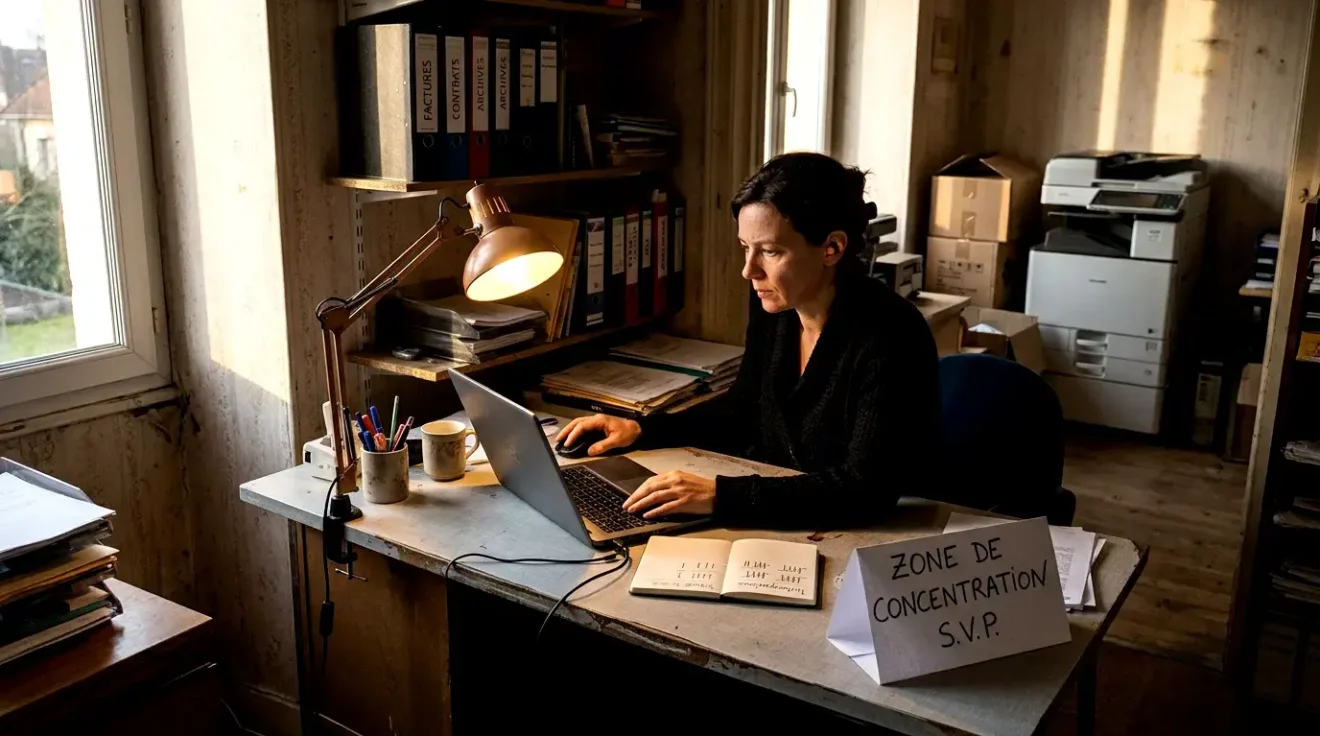
- Introduce a visible availability signal. A simple desk indicator or shared calendar status can distinguish protected concentration periods from moments when spontaneous questions are welcome. Urgent matters still need an agreed escalation route.
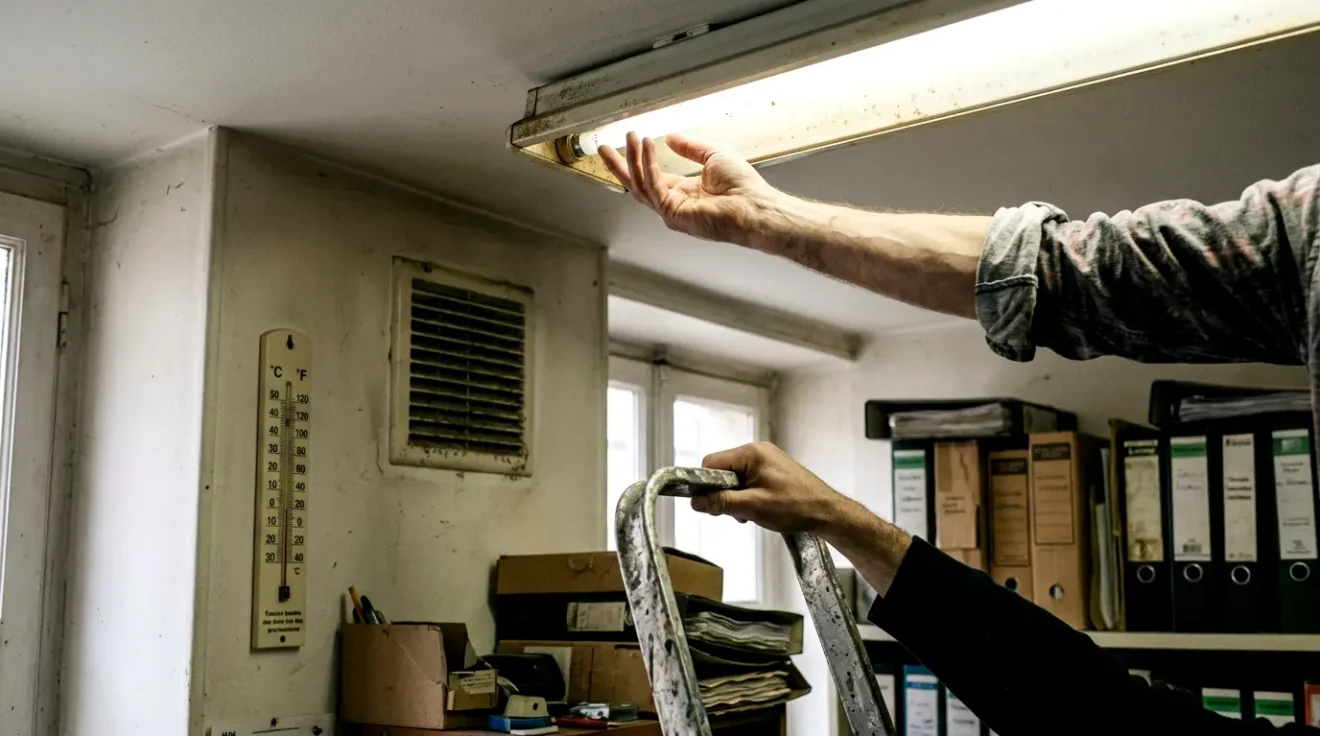
- Improve lighting and ventilation. Adjust blinds, maintain lighting fixtures, address ventilation faults and allow suitable local lighting where appropriate. Building-related interventions should be handled by authorised personnel.
- Relocate noisy shared equipment. Move printers and other suitable devices away from concentration areas, without obstructing escape routes or creating electrical and accessibility problems.
- Use external space selectively. A shared meeting room or occasional coworking day may offer a workable solution for particular activities when the existing office cannot provide sufficient separation.
These measures have different limitations. Availability signals fail if colleagues routinely ignore them. Coworking introduces recurring expenditure and potential confidentiality considerations. Desk rearrangements cannot compensate for unsuitable building conditions.
A common mistake is to begin with decorative purchases. New chairs, plants or wall colours may improve the perception of the office, but they do not necessarily address interruptions, uncomfortable temperatures or inadequate space for confidential conversations.
Organisational changes should be assessed before additional spending. A desk moved away from a busy corridor can have an immediate practical benefit, while a rule protecting concentration time may cost nothing to introduce.
Five actions for a 30-day workplace improvement test
- Record disturbances for five working days: produce a one-page log identifying recurring problems and affected areas.
- Map the existing office: create an annotated floor plan showing noisy equipment, circulation routes and concentration points.
- Select one priority intervention: document the chosen change, its owner and the problem it is intended to solve.
- Agree on one measurement: establish a simple baseline for interruptions, meeting-room availability or end-of-day fatigue.
- Review the result after 30 days: produce a short decision note stating whether to retain, adjust or discontinue the measure.
Employee participation is important throughout the experiment. A measure that appears efficient to management may create inconvenience for another team, particularly when shared equipment or seating arrangements change.
After the first month, keep the arrangements that reduce disruption without creating new difficulties. The next decision is how to allocate the existing space between concentration, cooperation and everyday social contact.
Open Space, Quiet Zones or Flexible Desks: Which Setup Fits Your Team?
The right office setup depends on how employees divide their time between individual concentration and collaborative work, and how closely their tasks depend on one another. Open spaces can support frequent exchanges, quiet zones protect attention, and flexible desks suit teams that are regularly mobile. Most businesses benefit from combining these approaches rather than selecting one exclusively.
Two questions help managers make a practical choice. First, how much time do employees spend on activities that require sustained concentration? Second, how frequently must they coordinate with colleagues to complete their work?
A customer support team handling shared operational issues may need frequent communication. Accountants, designers or analysts may require longer uninterrupted periods. A project team can need both conditions during the same week.
The following comparison provides a decision framework rather than a universal productivity ranking.
| Configuration | Best suited to | Main limitation |
|---|---|---|
| Open space | Teams requiring frequent coordination and quick exchanges | Conversations can disrupt individual concentration |
| Quiet zones | Writing, analysis, confidential or attention-intensive tasks | Dedicated space must be respected and managed |
| Flexible desks | Mobile teams with variable office attendance | Employees may lose personal reference points and convenient equipment access |
| Mixed zoning | Teams alternating between focused and collaborative activities | Requires clear rules and sufficient separation between zones |
Flexible working hours and flexible desks are not interchangeable. Allowing employees to choose their working times changes scheduling. Desk-sharing changes the physical relationship between employees and the workplace.
For a mostly office-based team, the absence of an assigned desk can introduce repeated setup work and weaken employees’ sense of belonging. Conversely, permanent desks may leave substantial space unused in a highly mobile organisation.
A practical compromise is to establish three spatial statuses: a protected quiet area, a collaboration area where conversations are expected, and a mixed area for ordinary individual tasks with occasional exchanges.
These categories need physical support. Distance, furniture orientation, available enclosed rooms and suitable acoustic treatment are more effective than signs that contradict what the space encourages.
However, an office designed only around silence can become socially fragmented. Informal discussions around a coffee machine, shared table or common area often allow employees to exchange useful information without arranging formal meetings.
Preserving these encounters is part of designing an effective workplace. Collaboration should have a recognisable place rather than being eliminated from the office.
The most suitable arrangement offers both predictable concentration and accessible social interaction. Its effectiveness also depends on less visible physical conditions that influence fatigue throughout the working day.
Which Working Environment Problems Quietly Increase Employee Fatigue?
Employee fatigue can increase when lighting is uncomfortable, ventilation is inadequate, temperatures are poorly controlled or workstations require awkward postures. These conditions may not cause an immediately obvious disruption, but repeated exposure can make ordinary tasks more tiring. Employees may attribute the resulting discomfort to workload rather than their physical environment.
Lighting problems are not limited to rooms that are too dark. Strong reflections on screens, direct glare from windows, uneven illumination and malfunctioning fixtures can create visual discomfort.
Temperature and air circulation also deserve attention. Employees working in uncomfortable thermal conditions may struggle to maintain attention, while poorly maintained ventilation can create persistent complaints about stuffiness or unpleasant air.
Ergonomic problems can be equally subtle. Screens positioned too low, unsuitable seating adjustments and frequently used objects placed beyond comfortable reach may encourage repeated awkward movements.
Managers can look for patterns such as recurring discomfort complaints, mistakes in familiar tasks, reduced participation late in the day and difficulties maintaining attention. An increase in short absences may also justify closer examination, but none of these indicators proves an environmental cause by itself.
One difficulty is the attribution of fatigue. Someone who feels exhausted after working in an uncomfortable space may report that their workload is excessive without identifying the lighting, temperature or workstation arrangement as possible contributing factors.
Before concluding that employees lack motivation or resilience, managers should investigate the working conditions. A simple environmental review can include employee feedback, inspection of lighting and ventilation, and checks that workstations suit their users.
In France, these considerations also have a regulatory dimension. The French Labour Code provisions on workplace lighting and thermal conditions include requirements concerning visual comfort and illumination.
For example, Article R4223-4 specifies a minimum of 120 lux for workplaces within its scope, while Article R4223-5 requires illumination to be adapted to the nature and precision of the work. These are regulatory requirements, not a universal recommendation for ideal screen-work lighting.
Ventilation is governed by other applicable provisions, which must be checked separately. The employer’s broader health and safety obligations also require workplace risks to be assessed and addressed appropriately.
Changes involving electrical installations, building ventilation or other technical systems should be undertaken by competent personnel. An inexpensive improvement is worthwhile only if it remains safe and compliant.
Regular checks help managers distinguish maintenance problems from organisational issues. As a company grows, these environmental pressures can become more difficult to manage without a broader review of space allocation.
When Should You Redesign the Working Environment as the Team Grows?
A working environment should be reconsidered before growth causes persistent overcrowding, unavailable meeting rooms or improvised desk-sharing. Early warning signs include simultaneous attendance approaching capacity, frequent competition for quiet spaces and employees working remotely mainly because the office cannot accommodate them comfortably. Planning ahead gives managers more options than reacting after these problems become routine.
Growth changes the relationship between people, space and working practices. An arrangement that functions comfortably with five employees may become unreliable with fifteen, even if the work itself remains similar.
In a small team, employees may coordinate through informal conversations and shared assumptions. As more people join, these conventions become harder to transmit. New colleagues cannot automatically know which desks are reserved for concentration or when spontaneous interruptions are acceptable.
Managers therefore need to distinguish two forms of redesign.
- Physical redesign: changing the placement, number or function of desks, meeting rooms, circulation routes and shared facilities.
- Organisational redesign: adapting attendance schedules, meeting practices, hybrid arrangements, booking procedures and availability expectations.
A larger office will not resolve unclear collaboration rules. Equally, introducing flexible schedules cannot always correct severe space limitations or unsuitable physical conditions.
A useful planning exercise is to assess several scenarios for the next 12 to 18 months. Consider current staffing, anticipated recruitment and possible changes in office attendance.
For each scenario, estimate which activities will need simultaneous space and which could reasonably be separated by schedule or location. Avoid assuming that every employee will either always attend or never attend.
Hypothetical example: a team growing from 10 to 16 employees
A small consultancy with ten employees has enough workstations but only one meeting room. It plans to recruit six additional employees over the following year. Rather than immediately signing a larger lease, management examines expected attendance and identifies occasions when confidential calls and collaborative meetings overlap.
The company tests an appointment system for its meeting room, designates a small quiet area and explores occasional access to a nearby shared room. These steps do not guarantee that expansion will be unnecessary, but they reveal which capacity constraints genuinely require investment.
Modular furniture, movable partitions where suitable, and flexible external-space arrangements can preserve options during uncertain growth. Decisions should nevertheless account for accessibility, safety, confidentiality and the real cost of repeated reconfiguration.
The objective is neither to maximise occupancy at all costs nor to purchase unused capacity far in advance. It is to maintain enough flexibility to support expected activity without making daily work increasingly difficult.
Space planning should be accompanied by explicit working agreements and employee involvement. Otherwise, even a technically suitable office may leave people feeling that they have little influence over their daily conditions.
Why Do Employees Disengage Even When Working Conditions Seem Reasonable?
Employees can disengage in an apparently acceptable workplace when they experience little control over their surroundings and feel that recurring concerns are ignored. Adequate furniture, acceptable temperatures and modern facilities do not automatically create a supportive environment. The ability to influence everyday conditions and receive meaningful responses to feedback also matters.
Consider two offices with similar equipment. In one, employees can discuss noise problems and agree on adjustments. In the other, temperature settings, desk placement and interruptions are treated as fixed conditions over which employees have no influence.
Although the physical facilities may be comparable, the experience of working in them can differ substantially.
Perceived control matters because it shapes how employees experience everyday constraints. A temporary inconvenience may be tolerable when people understand its cause and know how to request a change. The same problem can become frustrating when complaints repeatedly produce no response.
Disengagement is not always visible through resignations or direct confrontation. It can appear as reduced willingness to contribute ideas, fewer spontaneous exchanges or limited participation in improvements.
Managers should avoid interpreting individual behaviours too quickly. Arriving late, withdrawing from conversations or leaving personal belongings at home can have many explanations. Such observations are useful as reasons to start a respectful conversation, not as evidence of poor motivation.
A better diagnostic approach combines several perspectives:
- Recurring environmental complaints and whether they were addressed.
- Changes in collaboration and voluntary participation.
- Employee descriptions of their ability to control interruptions or choose suitable working conditions.
- Evidence that previous workplace improvements actually resolved the reported problems.
Annual satisfaction surveys can provide context, but they may miss changes occurring between survey periods. Short, regular discussions about practical working conditions can reveal problems earlier.
There is also a difference between a visible investment and a useful response. Purchasing attractive furniture after repeated complaints about noise may signal that management is prioritising appearance over employees’ actual difficulties.
By contrast, a modest change directly addressing a persistent complaint can demonstrate that feedback influences decisions. This does not guarantee stronger engagement, but it removes a potential source of frustration.
A responsive environment gives employees practical reasons to trust the improvement process. The same principle should guide decisions about where people work, particularly when remote and hybrid arrangements become part of the company’s operating model.
Remote, Hybrid or Office-Based: Which Setup Best Supports Team Productivity?
Remote, hybrid and office-based arrangements can all support productivity when matched to the activities employees perform. Remote work may provide better concentration for some tasks, while office attendance can simplify coordination, practical training and informal exchange. Hybrid work combines these possibilities but requires deliberate scheduling to avoid fragmented teams and poorly used offices.
Working from home is sometimes presented as a solution to noisy or overcrowded offices. It can reduce exposure to those particular disruptions, but it may introduce different constraints, including isolation, unsuitable home equipment and more complicated communication.
Likewise, bringing everyone into the office does not automatically improve collaboration if employees spend most of their time in unrelated meetings or individual online calls.
The appropriate decision therefore depends on the task rather than a general belief that one location is always more productive.
| Type of activity | Arrangement to consider | Condition for success |
|---|---|---|
| Complex writing, analysis or individual preparation | Remote work or a protected quiet office zone | Suitable equipment and limited interruptions |
| Highly interdependent project work | Coordinated office attendance or structured hybrid collaboration | Shared availability and clear responsibilities |
| Onboarding and practical mentoring | Planned in-person sessions supported by remote follow-up | Accessible colleagues and organised knowledge transfer |
| Routine administrative activities | Office-based, remote or hybrid according to operational constraints | Reliable systems, confidentiality and clear expectations |
The most important hybrid-working problem is often coordination rather than the number of remote days. If employees attend on different days, the office may be relatively empty when collaboration is needed, while people repeatedly travel in for activities they could complete elsewhere.
Managers can address this through shared attendance periods linked to specific activities, while preserving reasonable flexibility for tasks that do not require physical presence.
Office attendance should have a practical purpose. Planning sessions, mentoring, collaborative problem-solving and team exchanges are stronger reasons for bringing people together than an arbitrary assumption that visibility guarantees performance.
In France, teleworking arrangements must also fit the applicable legal framework. The Service Public guidance on private-sector teleworking in France explains that telework may be organised through a collective agreement, an employer’s charter or, where neither exists, an agreement between employer and employee.
Specific arrangements should address the organisation of telework and applicable obligations, including equipment, professional expenses and employee representation where required. The correct treatment depends on the circumstances and relevant legal or collective provisions.
Employee expectations and recruitment considerations may also influence the choice, but they should be examined through current workforce feedback rather than assumed to be identical across all organisations.
A suitable arrangement reduces avoidable disruption while maintaining collaboration. The final measure of success is not how occupied the office appears, but whether employees can achieve their responsibilities without unnecessary additional pressure.
Key takeaways for managers
- Recover wasted capacity before demanding additional output: interruption recovery, unnecessary movement and coordination failures are useful starting points.
- Measure working conditions alongside results: improvements should make work easier to complete, not simply increase performance expectations.
- Build a repeatable review process: maintain a short cycle of employee feedback, targeted experiments and evidence-based decisions.
How Can Workplace Productivity Improve Without Increasing Pressure on Employees?
Workplace productivity can improve without increasing pressure when managers remove unnecessary obstacles rather than demanding greater intensity. Fewer interruptions, clearer coordination and better working conditions allow employees to complete existing responsibilities with less wasted effort. The aim is to recover time and attention already being consumed by avoidable friction.
This distinction changes how a company evaluates improvement. Instead of asking employees to process more tasks immediately, management first identifies where normal working time is being lost.
For example, recurring delays may result from repeatedly searching for an available meeting room, rebuilding concentration after interruptions or duplicating work because responsibilities are unclear.
These losses can be documented without imposing intrusive individual monitoring. Teams can track practical indicators such as the frequency of interruptions, meeting-room conflicts or time spent resolving duplicated work.
A simple measurement model compares the same activity before and after an environmental change, while considering workload and other factors that could influence the result.
Three questions help interpret the findings:
- Was a specific source of friction reduced? For example, did employees experience fewer unwanted interruptions during concentrated tasks?
- Did the work become easier to complete? Consider employee-reported effort, avoidable delays and recurring errors alongside normal operational outcomes.
- Were new difficulties introduced? An apparently successful quiet-zone policy might unintentionally make legitimate collaboration harder.
A reduction in interruptions should not automatically become a justification for increasing individual targets. The benefit may instead appear as fewer late finishes, less fatigue, more reliable output or greater capacity to manage normal variations in workload.
Adding productivity software without correcting environmental problems can produce the opposite result. More notifications, tracking requirements and competing targets may create additional interruptions rather than removing existing ones.
Managers should also avoid attributing every performance variation to the workplace. Changes in staffing, task complexity, client demand and organisational priorities can affect outcomes. A 30-day test provides useful operational feedback, but it is not necessarily proof of a direct causal relationship.
The sustainable alternative is a short periodic workplace review. Employees identify recurring friction, management selects a manageable intervention, and the team evaluates whether the change should continue.
Over time, this process makes workplace design an ongoing management responsibility rather than an occasional renovation project.
Start with one week of observation, agree on one change with the team and review its effects after 30 days. The objective is straightforward: make existing work more achievable, protect employee wellbeing and invest further only when the evidence supports doing so.
Can a small company improve its office without changing premises?
Yes, if the main problems can be addressed within the existing space. Rearranging desks, improving equipment placement, introducing concentration periods and coordinating meeting-room use may help. However, inadequate capacity, safety problems or unsuitable building conditions may require physical work or different premises.
How much should a small business budget for workplace improvements?
There is no universal amount. Some interventions, such as changing communication rules or rearranging existing furniture, require little direct expenditure. Others involve equipment, professional maintenance or recurring external-space costs. Establish the main problem first, then compare the cost and practical limitations of suitable solutions.
How can managers assess workplace noise without specialist equipment?
Employees can record where and when distracting noise occurs, which activities are affected and whether disturbances come from speech, equipment or circulation. This provides an initial diagnostic picture. It does not replace professional acoustic measurements or a formal occupational risk assessment where these are needed.
Should employees be allowed to personalise their workstations?
Reasonable personalisation can help employees feel comfortable and maintain a sense of ownership over their workspace. Managers can establish clear limits covering safety, hygiene, accessibility and shared-space use. In desk-sharing environments, providing suitable storage and predictable equipment access may be more practical than assigning permanent personal spaces.
How often should working environment improvements be reviewed?
A 30-day follow-up is a practical way to evaluate an initial low-cost experiment. Afterward, short periodic reviews can identify recurring problems and changing needs. More immediate action may be necessary when employees report health, safety or serious environmental concerns. The review schedule should complement, not replace, the employer’s applicable prevention and risk-assessment obligations.